Your name is more than a label. It is a sound, a meaning, and when written down, a visual symbol that connects you to thousands of years of human civilisation. But what does your name look like when written in Arabic? Or Chinese? Or the same script that ancient Greek philosophers used?
We built Name in Scripts, a free tool that instantly shows any name written in 14 different writing systems from around the world. No signup required. Just type your name and watch it transform.
Why Writing Systems Matter
Every writing system is a window into a culture's history, values, and way of thinking. The angular precision of Korean Hangul reflects its deliberate creation by King Sejong in 1443. The flowing curves of Arabic calligraphy carry centuries of Islamic artistic tradition. The pictographic origins of Chinese characters connect modern readers to 3,200-year-old inscriptions on oracle bones.
When you see your name in these scripts, you are not just seeing a transliteration. You are seeing your identity filtered through different cultural lenses, each with its own aesthetic sensibility and historical depth.
The 14 Scripts We Support
Our tool covers writing systems spanning five millennia and four continents:
Alphabetic Scripts
- Latin: The script you are reading now, used by over 2 billion people worldwide. Descended from ancient Roman lettering, it spread globally through European colonisation and remains the dominant script for international communication.
- Cyrillic: Created in the 9th century CE for Slavic languages, now used across Russia, Ukraine, Bulgaria, Serbia, and Central Asian nations. Named after Saint Cyril, who adapted Greek letters for Slavic sounds.
- Greek: One of the oldest alphabets still in use, dating to around 800 BCE. The source of both Latin and Cyrillic scripts. Every mathematical equation and scientific formula uses Greek letters.
- Georgian: A unique alphabet found nowhere else in the world, created around the 5th century CE. Its rounded letters are instantly recognisable and remain unchanged for over 1,500 years.
- Armenian: Invented in 405 CE by the scholar Mesrop Mashtots specifically to translate the Bible. Like Georgian, it exists as an island, unrelated to any other writing system.
Abjads and Abugidas
- Arabic: Written right-to-left, Arabic script is used for Arabic, Persian, Urdu, and historically many other languages. Its cursive nature means letters change shape depending on their position in a word.
- Hebrew: Another right-to-left script, Hebrew was revived as a spoken language in the 19th century after centuries of being used primarily for religious texts.
- Devanagari (Hindi): The script of Hindi, Sanskrit, Marathi, and Nepali. Recognisable by the horizontal line (shirorekha) that runs along the top of words, connecting letters together.
- Thai: A beautiful curving script with no spaces between words. Readers must identify word boundaries from context, which means Thai literacy requires recognising thousands of common word shapes.
- Bengali: Used for Bengali and Assamese, spoken by over 230 million people. Like Devanagari, it features a distinctive headline, but with more curved and flowing letterforms.
- Tamil: One of the oldest living languages, with inscriptions dating back over 2,000 years. Tamil script has a distinctive rounded appearance, evolved from ancient Brahmi writing.
Logographic and Syllabic Scripts
- Chinese (Hanzi): The oldest writing system still in widespread use, with characters dating back 3,200 years. Each character represents a morpheme rather than a sound, allowing speakers of mutually unintelligible Chinese dialects to read the same text.
- Japanese (Katakana): Japanese uses three scripts: Hiragana, Katakana, and Kanji (borrowed Chinese characters). For foreign names, Katakana is standard. Each symbol represents a syllable rather than a single sound.
- Korean (Hangul): Arguably the most scientifically designed alphabet in history. King Sejong the Great created it in 1443 CE so that commoners could read and write. The shapes of consonants actually represent the position of the tongue and mouth when pronouncing them.
Features That Bring Your Name to Life
Simply displaying your name in different scripts is just the beginning. We added features to help you truly engage with each writing system:
Audio Pronunciations
Click the speaker icon on any script card to hear how your name sounds in that language. We use native speaker audio to give you an authentic pronunciation, not a robotic approximation. This is particularly useful for scripts like Arabic and Chinese where the transliteration might not be intuitive for English speakers.
Stroke-by-Stroke Animations
For Chinese and Japanese characters, you can watch and practise the exact stroke order. Each character has a specific sequence of strokes that native writers learn from childhood. Getting the stroke order right is considered essential for proper handwriting and is still taught in schools across East Asia.
Click the brush icon on the Chinese or Japanese card to open an interactive animation. You can watch it play automatically, or switch to practice mode and trace the strokes yourself.
Historical Timeline
Below your name results, an interactive timeline shows when each script originated. Seeing Egyptian Hieroglyphics at 3200 BCE next to Korean Hangul at 1443 CE puts the vast span of human writing history into perspective. Your name connects to all of it.
Cultural Meanings and Equivalents
Many names have equivalents across cultures. John becomes Yahya in Arabic, Ivan in Russian, Jean in French, and Giovanni in Italian. Our tool shows you these connections, plus the original meaning and etymology of your name if it is in our database.
This feature reveals how names travel across cultures and time. The Arabic Yahya and the English John both trace back to the Hebrew Yohanan, meaning "God is gracious". Despite sounding completely different, they are the same name.
Video Generation
Want to share your name's journey through writing systems? Click the Create Video button to generate a shareable video showing your name morphing through all 14 scripts. Perfect for social media or simply a fascinating keepsake.
A Brief History of Writing
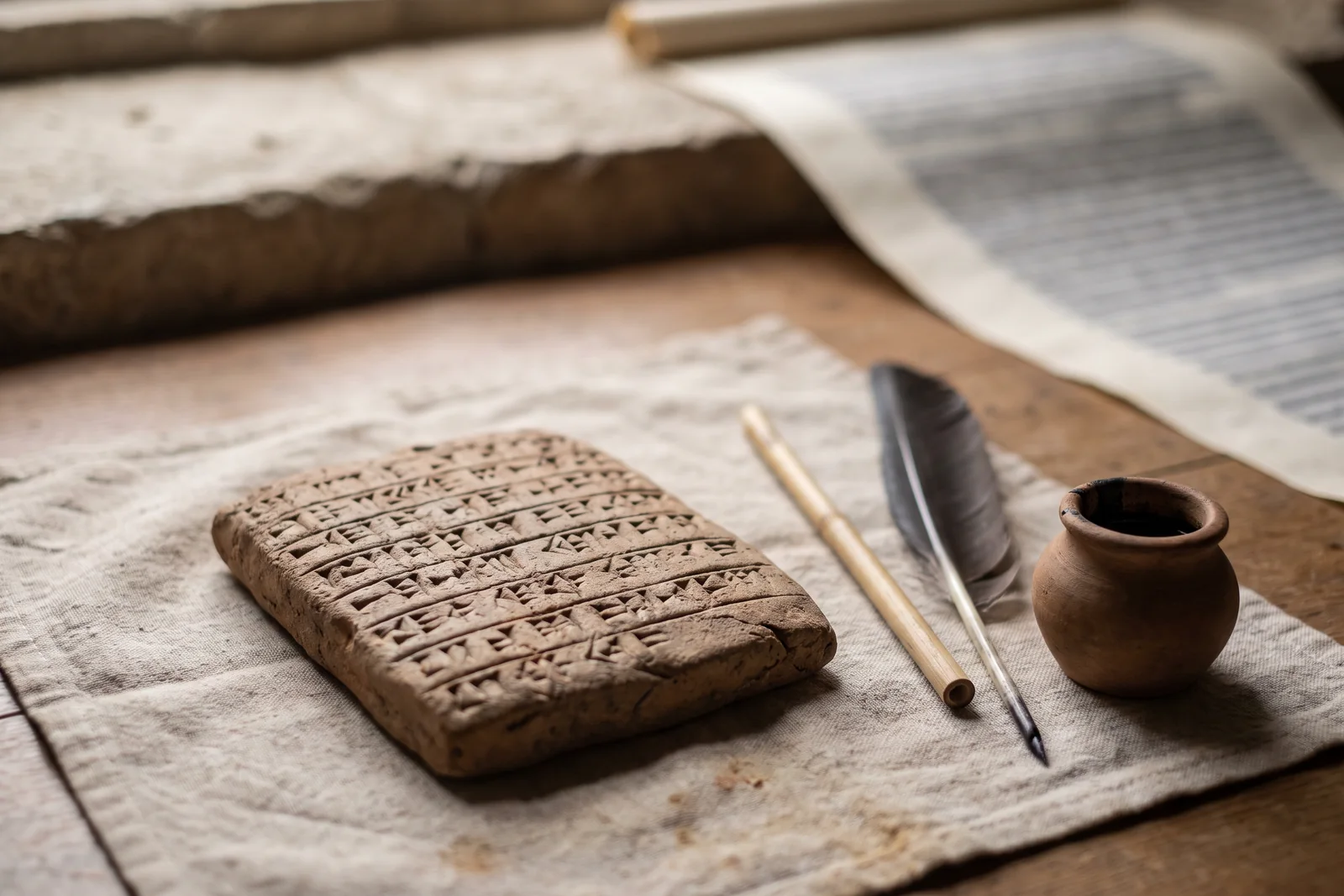
Writing emerged independently in at least four places: Mesopotamia, Egypt, China, and Mesoamerica. The earliest known writing, Sumerian cuneiform, appeared around 3400 BCE in what is now Iraq. Egyptian hieroglyphics followed shortly after.
The Phoenician alphabet, developed around 1050 BCE, was revolutionary. Instead of hundreds of symbols representing words or syllables, it used just 22 letters representing consonant sounds. This efficiency made literacy far more accessible.
The Greeks adapted the Phoenician alphabet around 800 BCE, crucially adding vowels for the first time. This Greek alphabet then split into two branches: one became Latin through the Etruscans and Romans, the other became Cyrillic through Byzantine missionaries to the Slavs.
Meanwhile, in South and East Asia, entirely different traditions developed. Chinese writing evolved from oracle bone inscriptions used for divination in the Shang dynasty. Indian scripts descended from Brahmi, which may have been inspired by Semitic scripts but developed its own distinct principles.
Every time you write your name, you are participating in this 5,000-year conversation.
How We Transliterate Names
Transliteration is not the same as translation. We are not converting meaning, but sound. When you type "Michael", we find the characters in each script that most closely approximate the sounds in your name.
This is straightforward for alphabetic scripts like Cyrillic or Greek. For Chinese and Japanese, it is more complex because these scripts were not designed to represent foreign sounds. Chinese uses a standard set of characters (通用规范汉字表) for transcribing foreign names, chosen to approximate sounds while avoiding characters with negative meanings.
For Arabic, we follow common conventions for rendering English names, but there can be variations. "Michael" might be written as ميخائيل (Mikha'il, following the Biblical tradition) or مايكل (a more direct phonetic rendering). We use the most widely recognised form for each name.
Try It Yourself
Head to Name in Scripts and type your name. Download the images, generate a video, or simply explore the beautiful diversity of human writing systems.
Every script tells a story. Every name has a history. See where yours fits in.